Denver Clark, ERYT-500, C-IAYT
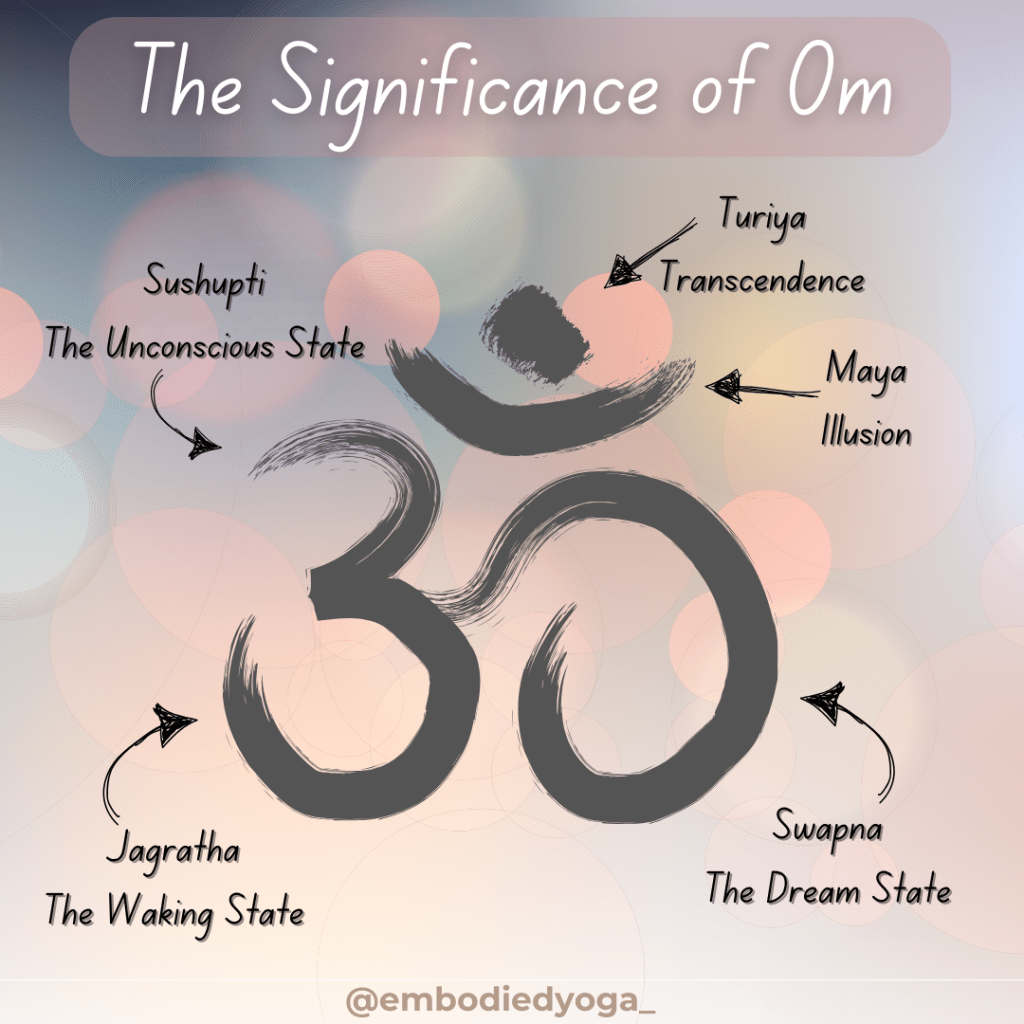
Om is the primordial sound of the universe. You’ve heard it chanted perhaps thousands of times, but do you truly understand its significance?
In the Vedas, it is said that the entire universe was created form a single sound. This sound was Om. The great inventor and scientist Nikola Tesla once said, “If you want to find the secrets of the universe, think in terms of energy, frequency, and vibration” and the sound of Om is a perfect reminder of this. In yoga, we also learn that all things in the universe vibrate, and energetic frequencies are a large part of the study of yoga, the subtle body and the panchamaya koshas, or states of being. Among the many different and powerful representations of the symbol of om, my favorite is that of the journey we take from the outside world inward toward enlightenment.
Each curve in the symbol represents a different part of our consciousness:
- The bottom curve represents Jagratha, or the waking state. This is the state of consciousness when we are preoccupied with the outside world, living in our body and experiencing life through the 5 senses. This is not a negative state to be in, but if we allow ourselves to identify only with our body and look to the outside world for happiness, we find ourselves living in a state of self-induced suffering. Yoga teaches us that we are not our bodies. Our body has the shortest life span of all the layers of our being and when we die, we don’t take anything from this state with us.
- The middle curve represents Swapna, or the dream state. This is the state of subconsciousness where we withdraw from the outer world and begin the journey inward. Many practitioners experience thoughts, memories and emotions when they reach this state in meditation. This is where our energetic and emotional bodies live, creating the “dream” we experience in this life. Some people refer to this as our “monkey mind,” meaning that in this state our minds can run amok and wreak havoc on our mood, triggering unwanted actions. Yoga teaches us however, that we are also not our emotions or thoughts and if we stay stuck in this state or allow ourselves to be easily triggered by the deep seated emotions that arise here, we suffer from ruminating thoughts and fears. In this state it is best to be the observer and remember not to attach to thoughts and emotions. This allows us to travel deeper to the next state of consciousness.
- The upper curve represents Sushupti, or the sleeping state. This is a state of unconsciousness where we are neither awake, nor dreaming but simply existing. We begin to understand that we are not our bodies or minds and we are not the things that have happened to us. In this state, we reach nothingness. Some practitioners say they feel this state in savasana or in deep moments of meditation when all else falls away.
- The swoop at the top represents Maya, or illusion. This is the preoccupation we have in our small selves with the body, thoughts and 5 kleshas (obstacles to enlightenment). Through dedicated practices, detached awareness and living the philosophies of yoga, it is said we can break through this state of illusion and reach enlightenment.
- The dot represents transcendence. This is the fourth and final state of awareness. When we travel through the 3 lower states of awareness – waking, dreaming and deep sleep, we can systematically unravel the causes of our own suffering – those things that we attach to in identification. Only by facing these things honestly and openly can we truly reach enlightenment. The practice of meditation helps bring us to this state.
It’s important to recognize the cultural significance of this ancient symbol of Om as well. It is not meant to be tattooed on your body or placed in an area of disrespect (a bathroom, for example). If we are to truly practice authentic Yoga, we must learn the history and meanings of the practices we engage in and do our best to respect and honor these traditions.
When chanted aloud, the three letters of A – U – M represent a number of sacred trinities:
1. The different conditions of consciousness — the waking state, the dreaming state, and the deep sleep state.
2. The deities in charge of the creation, preservation, and destruction of the universe — Brahma, Vishnu, and Shiva.
3. The three original Vedic scriptures — Rg, Yajur, and Sāma.
4. The three gunas – ragas, satva & tamas
5. The three aspects of time — past, present, and future.
There is so much more to Om.
I encourage you to consider this sacred symbol and chant more to fully respect its history and depth.
 Embodied Health
Leave a comment