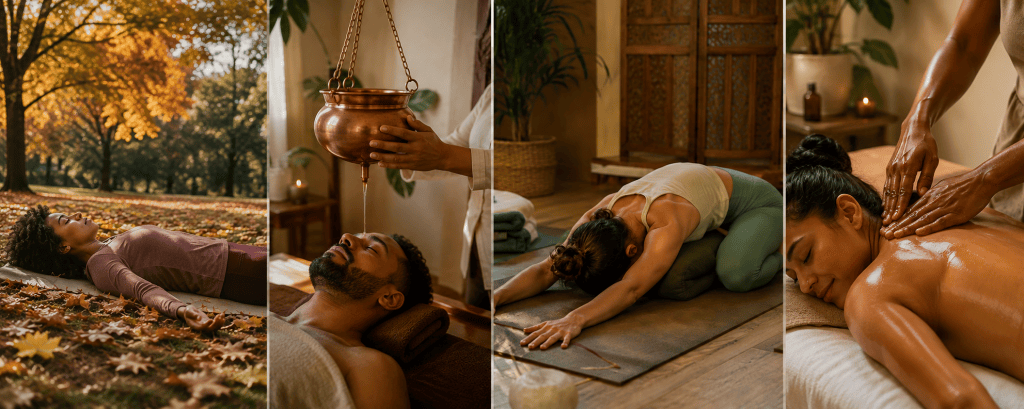
There is something unmistakable about the transition into fall. Even here in Florida, where cooler temperatures are still a while away, the rhythm begins to change. The evening light begins to yellow as days slowly shorten and the intensity of summer gives way to something different.
Ayurveda reminds us that just like seasonal changes in nature, our needs are not static. We are continually in relationship with our environment and as the outer world changes, we are invited to be intentional with the patterns we engage in as well.
One of Ayurveda’s most practical teachings is ṛtucaryā (ri-too-chuh-ryah ) the practice of adjusting our routines with the seasons.
Rather than following the same wellness routine all year long, Ayurveda invites us to notice the qualities present around us and within us, then consider what might bring greater balance.
Understanding Vata Season
Ayurveda describes the natural world through five elements—earth, water, fire, air, and space—which combine to form three organizing principles known as the doshas: Vata, Pitta, and Kapha.
Vata is associated primarily with air and space and is characterized by qualities such as:
Dry • Light • Cool • Mobile • Subtle • Irregular
As we move toward fall, many of these qualities become increasingly apparent in the environment. Depending on where you live, you may notice cooler or drier air, more wind, changing daylight, shifting routines, and a general sense of movement and transition.
Here in Florida, September may not look like the quintessential autumn scene of sweaters and falling leaves. Ayurveda, however, asks us to pay attention to qualities rather than dates on a calendar.
What is happening in your environment?
And what is happening within you?
You may notice that life feels a little more scattered or irregular. Your skin may become drier. Your appetite or digestion may change. Perhaps you’ve been moving quickly and craving more steadiness.
None of this automatically means that your “Vata is out of balance,” however it does provide a moment of pause to ask:
What qualities would offer appropriate balance right now?
As we enter a season characterized by transition and movement, practices that emphasize warmth, nourishment, rhythm, steadiness, and rest can be particularly supportive.
1. Create Rhythm Where You Can
One of the simplest ways to work with the mobile and irregular qualities associated with Vata is through consistency. Not a rigid schedule of rules, but the kind of consistency you would provide a young child to help soothe their nervous system and provide structure.
- Could you eat lunch at approximately the same time most days?
- Could you create a simple bedtime ritual?
- Could your morning begin with five quiet minutes before reaching for your phone?
When everything around us seems to be moving, predictable rhythms can provide an anchor.
Ayurveda calls these everyday practices dinacharya (din-ah-CHAR-yah) daily routine. The individual practices can vary, but the underlying idea is lovingly simple: What we do regularly matters.
2. Begin Bringing More Warmth to Your Meals
Seasonal eating in Ayurveda isn’t about following a perfect “diet.” It is about noticing the qualities of what we consume and how they affect our inner vibrations.
As we move away from summer, consider gradually shifting from an abundance of cold, raw, light foods toward meals that feel warm, cooked, moist, and nourishing.
Think:
- soups and stews
- oatmeal or warm grains
- roasted root vegetables
- rice and lentils
- cooked seasonal vegetables
- healthy oils and fats
- warm teas
- gently warming spices
Begin to notice how do you feel after a cold smoothie compared with a warm breakfast? How does a large raw salad feel compared with cooked vegetables and rice?
Ayurveda continually brings us back to this kind of observation. The goal isn’t to eat according to a chart. It is to become more skillful at recognizing how food actually affects you.
3. Discover the Ayurvedic Practice of Oil Massage
One of the most beloved practices in Ayurveda is Abhyanga (ub-HYUNG-guh**)**, the application of warm oil to the body.
Traditionally, self-Abhyanga is incorporated into a person’s daily routine prior to bathing in the morning to soothe the nervous system.
Oil is applied generously and intentionally to the body using rhythmic strokes, bringing lymph and blood back toward the heart and nourishing the deeper tissues of the body.
From an Ayurvedic perspective, the qualities of oil—warm, smooth, heavy, and rich – provide a natural counterpoint to the dry, light, cool, and mobile qualities associated with Vata.
Abhyanga practice doesn’t have to be elaborate. It can be as simple as warming a little sesame or coconut oil between your hands and massage your feet before bed.
You can also experience Abhyanga as professional Ayurvedic bodywork and let the grounding practice of touch become a luxurious ritual for body and soul.
At Embodied Health, Ayurvedic Abhyanga offers an opportunity to step away from doing and simply receive. Warm oil and rhythmic touch create a deeply nurturing bodywork experience rooted in Ayurvedic tradition.
Massage or Abhyanga: Which Should I Choose?
We offer both therapeutic massage and Ayurvedic bodywork at Embodied Health, and we’re often asked how they differ.
Choose Therapeutic Massage when… You’re looking for individualized bodywork focused on areas of muscular tension, discomfort, mobility, or simply the kind of pressure and massage techniques your body is craving that day. A massage session can be adapted to your individual needs and preferences.
**Choose Abhyanga when…**You’re interested in experiencing a traditional Ayurvedic oil practice. Abhyanga uses generous amounts of warm oil and rhythmic strokes across the body. Rather than spending most of the session working deeply into one particular muscle or “knot,” the practice emphasizes the experience of the body as a whole. It can be an especially beautiful practice during seasons when you’re craving warmth, nourishment, slowness, and intentional care.
4. Let Your Movement Practice Change With You
Your yoga practice doesn’t need to look the same in every season—or even every day. If life already feels fast, scattered, or overstimulating, adding more intensity isn’t always the answer. You might experiment with practices that emphasize:
slower transitions • steadiness • longer pauses • comfortable breathing • contact with the ground • rest
This doesn’t mean you have to stop doing the movement you love.
Ayurveda is not asking us to label activities as universally “good” or “bad.” It asks us to look at the whole picture.
- If everything else in your life currently feels fast, what would happen if part of your practice became slow?
- If your attention feels scattered, what helps you gather it?
- If you’re constantly giving, where are you allowing yourself to receive?
These are Ayurvedic questions as much as they are yoga questions.
5. Make Space to Receive
Modern wellness culture can make self-care feel like another job. Drink the water. Do the workout. Meditate. Meal prep. Stretch. Journal. Take the supplements. Get enough sleep.
Ayurveda certainly includes practices we can do for ourselves. But care does not always have to mean doing more. Sometimes care looks like receiving.
- Receiving touch.
- Receiving rest.
- Receiving a meal someone else prepared.
- Receiving support.
- Receiving an hour in which you aren’t responsible for accomplishing anything.
Ayurveda Is More Than Knowing Your Dosha
For many people, their first encounter with Ayurveda is an online quiz:
What’s your dosha?
Those quizzes can be fun introductions, but Ayurveda is far richer than identifying yourself as “a Vata” or “a Pitta.”
Ayurveda offers a framework for understanding the relationships among constitution, current state, digestion, food, daily routines, seasons, environment, age, movement, rest, and the qualities we encounter every day.
Most importantly, it teaches us to pay attention.
Rather than asking, What is the perfect wellness routine? Ayurveda asks:
- What is present now?
- What do I need in this moment to feel balanced?
The answer is designed to change, just like the seasons.
Embodied Health is committed to creating a space in Bradenton where Ayurveda can be studied thoughtfully and experienced through practice. Alongside our educational offerings, we offer traditional Ayurvedic bodywork including Abhyanga, Garshana, and Shirodhara, as well as therapeutic massage, yoga therapy, and seasonal workshops.
Whether you begin by taking a class, experiencing your first Abhyanga, or simply eating a warm breakfast tomorrow morning, Ayurveda doesn’t require you to change everything.
It invites you to begin noticing.
Notice the season.
Notice the qualities.
Notice yourself.
And from there, choose what brings you a little closer to balance.


Leave a Reply