So much of modern life is organized around asking, “what comes next?”
We are often in a loop of constantly reaching for more….
The next goal.
The next accomplishment.
The next version of ourselves.
Even wellness can become another place where we are constantly trying to improve—be stronger, calmer, healthier, more flexible, more productive, more healed.
Traditional Yoga philosophy, however, asks a different question:
“When is enough enough?”
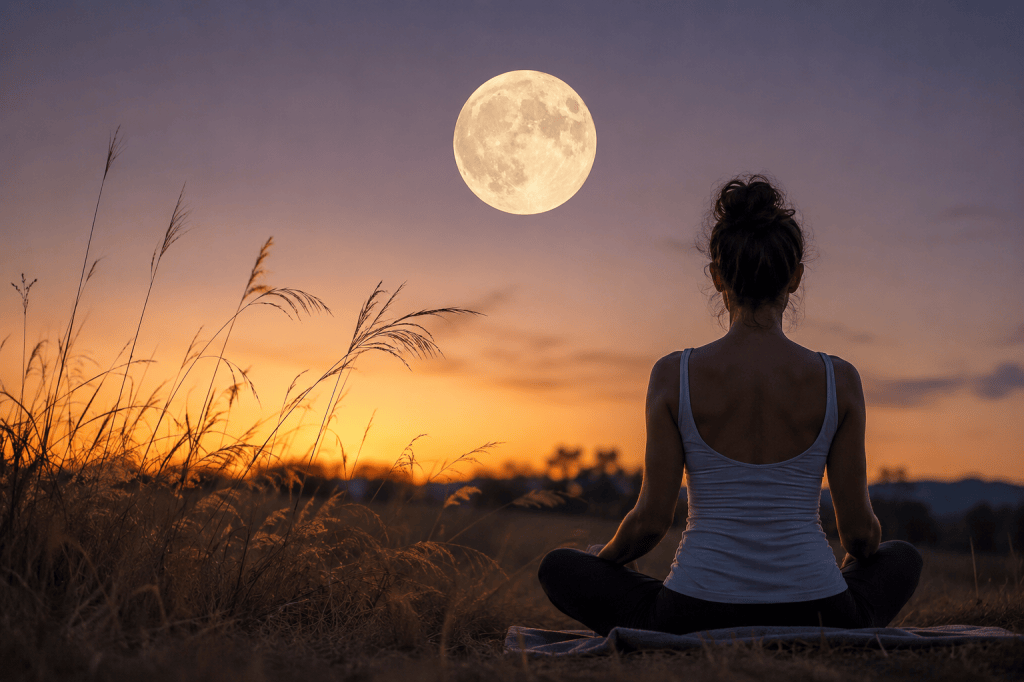
September’s Harvest Moon gives us a beautiful opportunity to explore one of yoga’s most deceptively simple teachings: santosha, the practice of contentment.
What Is the Harvest Moon?
The Harvest Moon is the full moon occurring closest to the autumnal equinox. Before electric light, the bright moon rising around sunset gave farmers additional evening light during an important time of year, allowing the work of gathering crops to continue after the sun had gone down. The fields had been tended. Seeds had been planted. Months of growth had taken place. Now came the harvest.
There is something powerful in this tradition even if we have never planted a field.
A harvest is a moment when attention shifts from what we are trying to create to what has already grown.
Santosha: The Practice of Enough
In the Yoga Sūtras of Patañjali, santosha is included among the niyamas, the personal observances that help guide a yogic life. It is commonly translated as contentment.
But contentment can easily be misunderstood.
Contentment is not Passive acceptance.
Santosha does not require us to pretend everything is wonderful. It does not mean accepting circumstances that need to change. And it certainly doesn’t mean abandoning ambition, growth, or meaningful action.
Instead, santosha asks us to examine our relationship with enough.
- Can I desire something without believing I am incomplete until I have it?
- Can I work toward change while still recognizing what is good now?
- Can I acknowledge difficulty without allowing it to erase everything else that is present?
- Can I recognize what has grown before immediately deciding what needs to grow next?
Santosha is not the absence of desire.
It is the practice of no longer making our peace dependent upon the fulfillment of every desire.
We Are Very Good at Seeing What Is Missing
Most of us don’t need much practice identifying what hasn’t happened yet. We notice the goal we haven’t reached, the habit we haven’t maintained, the body that doesn’t look or feel the way we wish it did and the version of ourselves we haven’t quite become.
When we attach to what is not present, often what is already here becomes almost invisible.
The practice of Yoga asks us to pay attention and along with the Harvest Moon, we are given an opportunity to direct that attention toward the abundance we may have stopped noticing.
Take Inventory of the Harvest
Imagine walking through a field at harvest time and looking only at the empty spaces, digging up every seed that failed to germinate, every plant that didn’t produce, every place where the crop didn’t grow exactly as expected.
When you focus on only what is not there, you miss seeing the whole field.
Santosha reminds us there is more than enough.
Perhaps this year, your body carried you through something difficult. Perhaps you learned to say no. Perhaps you tried something that frightened you.
Perhaps you rested when an earlier version of you would have pushed through. Perhaps you created something. Perhaps you loved someone well.
Perhaps you simply kept going.
Not every harvest looks the way we imagined when we planted the seeds.
That does not mean there is nothing to gather.
Contentment and Growth Can Exist Together
One of the fears we sometimes have about contentment is that if we become satisfied with what we have, we will stop growing. But nature doesn’t work that way, and neither should we.
A field can be emptied of its harvest and still be planted again.
A tree can bear fruit and yet continue growing.
The moon can disappear and will return as full again next month.
Yoga and Ayurveda remind us that there will always be another season.
Santosha allows us to interrupt the endless movement toward more long enough to experience the life that is actually happening.
We can still have dreams.
We can still make changes.
We can still plant new seeds.
But perhaps we don’t have to rush into the next planting before we have gathered this harvest.
 Embodied Health
Leave a comment